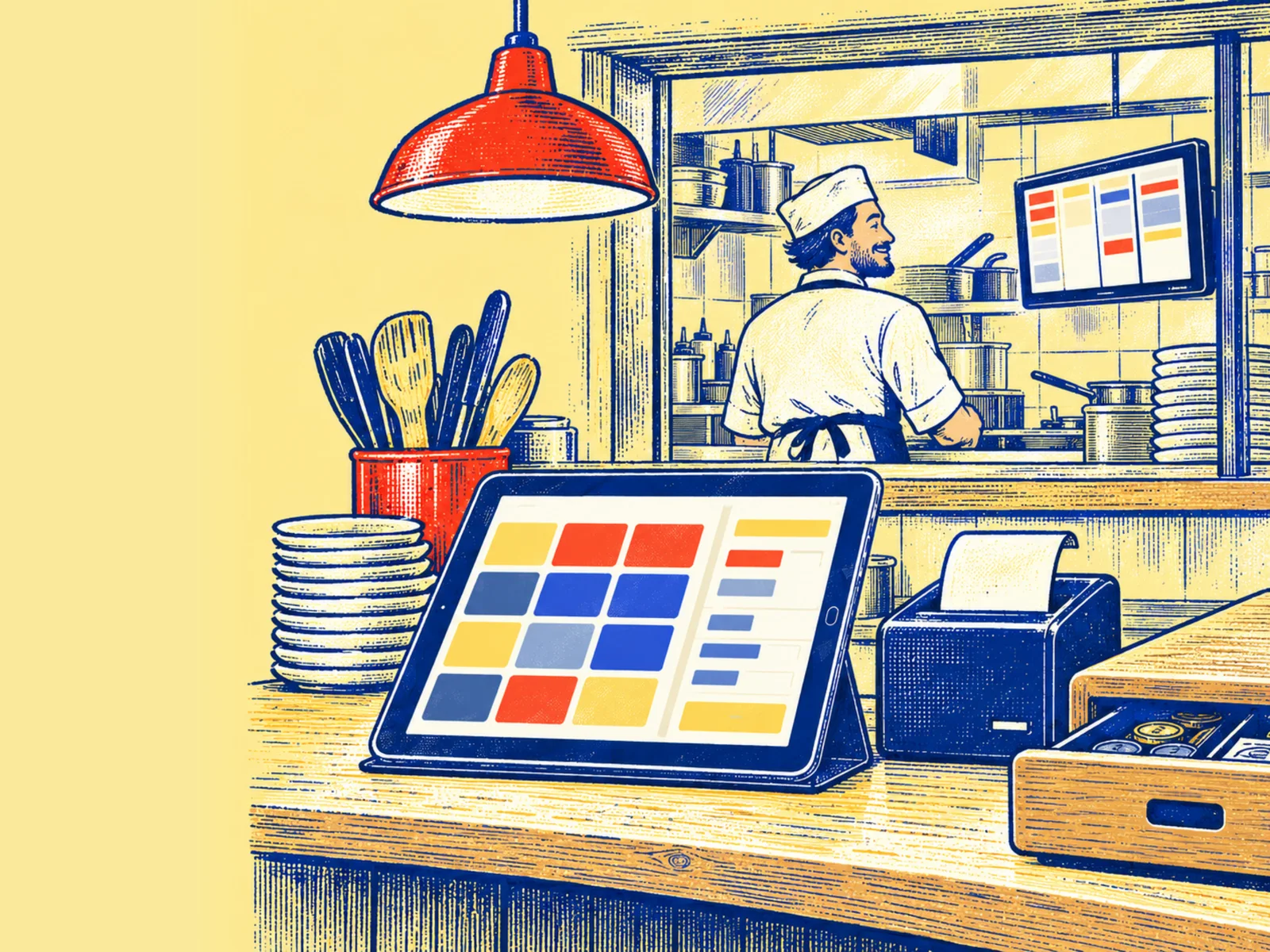
From the counter to the kitchen.
A till for a counter that serves food. It talks to the printers and the cash drawer, and it also knows who the customer is — because it is the same counter as the loyalty card.
The order is taken
The menu, the extras, the notes for the kitchen. Eat in, take away, or delivery — and a delivery asks where to go and who to call, because a driver at a closed door needs both.
One screen per cook
Orders spread themselves among whoever is there. An order already started never moves to another screen: nobody cooks the same dish twice.
Tickets print, the drawer opens
One ticket at the counter with prices, one in the kitchen without prices or drinks. The drawer opens on a cash payment, and never without a reason on record.
The day is counted
Orders, payments, card, cash, what is still to be collected, what must be refunded. The day starts at four in the morning: an evening that ends after midnight stays one evening.
And loyalty
The customer’s card is read at the till, the stamp lands on the visit they have just paid for, and the reward goes to the kitchen with the rest of the order.
The details that matter at 8 pm
These are not brochure features. They are the ones you miss on a Friday night.
- A parked basket always has a name. Three baskets called “no name” can no longer be told apart, and it always happens mid-rush.
- The price changes under a code. Giving a dish away, making a gesture: possible, recorded, and never above the menu price.
- A cancelled order gives back what it took. The stamp leaves, the reward returns to the card, and the kitchen sees the cancellation in red until it says “seen”.
- Nothing is lost if the network drops. The basket in progress stays, the screen says so, and nobody starts the order again.
The new till
Redrawn from top to bottom, and running since 17 October at the counter of our pilot restaurant.
Ten colours
Each shop picks its own: the till takes on its colours, not the other way round.
Three columns
To accept, in preparation, ready: you see at a glance where each order stands, and one that waits too long turns red.
One code per employee
Everyone opens the till with their name and code, and hands over to a colleague without closing anything.
A drawer that knows why
It opens with a code, and the reason is noted: a supplier, something else, or nothing taken out.
Closing time
Cash is counted, tomorrow’s float is chosen in the evening — and in the morning, it no longer moves.
The customer in one tap
On an online order, call the customer or message them, in a single gesture.
Around the till
The shop’s ordering site, and the space where everything is set up.
The ordering site
Eat in, take away or delivery, with online payment. The customer follows their order by text, from start to finish.
The figures
The day, the week, the month: collected, cash, card, online, refunded — day by day, ready to export or print.
Stock
Snap a photo of a delivery: supplier, lines, quantities and prices fill themselves in. You check, you confirm.
The team and expenses
Employees, their access, their hours, fixed costs and the day’s expenses, in one place.
It runs; it is not open to all yet
The new till is used every day at the counter of our pilot restaurant. That is how we learn what no trial ever tells us — and that is why the opening to all is not tomorrow.